
domingo, 22 de junio de 2014

Spanglish: A brief story
The first indications of the existence and everyday use among English and Spanish in the United States occur during the first half of the nineteenth century, following the occurrence of two nations, two cultures and at that time, two opponents.
With over thirty-five million Latinos, America is one of the largest Hispanic populations in the world. From the mixture of Spanish with English, and with origins dating back to 1848 when Mexico sold part of its territory to that country, was born on Spanglish.
The political instability that characterized Mexico's independent life after the war that freed him from the Spanish Crown (1810-1821) was capitalized by the U.S. expansionist interests in a time when the purchase and conquest was still resources for the acquisition of territory by the imperialist nations. The Treaty of Guadalupe Hidalgo decreed in 1848 the sale of half of Mexican territory, the present states of California, Arizona, Nevada and Utah and parts of Colorado, New Mexico and Wyoming, to end the American War. One hundred thousand Mexicans who left the north side of the new frontier suddenly became foreigners in their own land.
In this political and cultural rupture is followed by a series of events extending into the twentieth century, and which provide a passive presence of Spanish but ultimately live in this country. A broken Spanish force, dynamic, who had to mutate and adapt to their immediate universe a dimension that was written, read and spoken English. Here begins the merger.
In this flow of historical events that allowed the Spanish to stay here, includes the continued migration of peasants after the ravages of the Mexican Revolution (1910) are forced to move to agricultural activities in U.S. fields (1920). Years later, due to demand for labor by American involvement in World War II, this flow is formalized between the two governments to the agreement Bracero5 Program (1942-1964) In this same period of the twentieth century, the sons of peasants who came to the harvest season and had chosen to stay on this side, gave birth to the first generation of Mexican Americans. Thus arose the Chicano culture becomes more important where the linguistic code switching and mixing terms between the Spanish and English.
Shakespeare & English????
Shakespeare is probably the most famous of all Englishmen. One of the things he is famous for is the effect he had on the development of the Early Modern Englishlanguage. For example, without even realising it, our everyday speech is full of words and phrases invented by Shakespeare. He was able to do that because English was changing as people modernised it in their normal workaday speech.
One of the ways the grammar was changing was that inflectional endings (suffixes that indicated the word’s grammatical functions in the way that many modern languages still have) had largely disappeared. Modern English was becoming wonderfully flexible and that was the background to the Renaissance explosion of the inventive language we see when we look at the poetry of the time. Shakespeare was a leading figure in that.
Modern English
A major factor separating Middle English from Modern English is known as the Great Vowel Shift, a radical change in pronunciation during the 15th, 16th and 17th Century, as a result of which long vowel sounds began to be made higher and further forward in the mouth (short vowel sounds were largely unchanged). In fact, the shift probably started very gradually some centuries before 1400, and continued long after 1700 (some subtle changes arguably continue even to this day). Many languages have undergone vowel shifts, but the major changes of the English vowel shift occurred within the relatively short space of a century or two, quite a sudden and dramatic shift in linguistic terms. It was largely during this short period of time that English lost the purer vowel sounds of most European languages, as well as the phonetic pairing between long and short vowel sounds.
The causes of the shift are still highly debated, although an important factor may have been the very fact of the large intake of loanwords from the Romance languages of Europe during this time, which required a different kind of pronunciation. It was, however, a peculiarly English phenomenon, and contemporary and neighbouring languages like French, German and Spanish were entirely unaffected. It affected words of both native ancestry as well as borrowings from French and Latin.
Middle english
Middle English (ME) was the dominant and traditional spoken language form in many parts of England during the Middle Ages. Though most language historians suggest that prior to about 1000 CE, the primary language in England was Anglo-Saxon, the Norman invasion of England had significant effect on Anglo-Saxon. It gradually morphed the language into Middle English, a form almost recognizable, at least in text, as far more relative to modern spoken and written English.
History can have an intense effect on language. For England, the Norman invasion changed English forever. In the courts and in much of the writing of the time, French was definitely preferable, accounting for the numerous French-based words (over 10,000) that are now the common every day words of today’s English. Most documents dated after 1000 were written in either French or Latin, and Middle English drew from both, while still retaining some of its Anglo-Saxon roots. This in part accounts for the significant “exceptions” in English grammar, spelling, structure and pronunciation that can make English such a challenging language to learn, especially for those acquiring it as a second language.
Old english º_º
The island of Britain has not been successfully invaded since 1066 A.D. Before that date, however, the island had been occupied by Rome, the Anglo-Saxons and the Danish. The first incursions by Julius Caesar into Britain in 55 and 54 B.C. The dominant group in Britain were a Celtic people whose language is the ancestor of modern Welsh and Breton. When the British Celts were finally subdued by the Roman Emperor, Claudius, 43 A.D. ; Britain nominally became part of the Roman Empire , though it was not fully brought in line until 78 A.D. under the governor Agricola. Roman influence never penetrated the culture of the British Celts the way it did their continental neighbors, and Rome�s influence was negligible in the Pictish north and Celtic west.

History of english :)
English is primarily a West Germanic language that originated from the Anglo-Frisian dialects, brought to Britain byGermanic invaders and/or settlers from the places which are now called North West Germany and the Netherlands. It uses a vocabulary unlike other European languages of the same era. A large portion of the modern English vocabulary came from the Anglo-Norman languages. English is considered a "borrowing" language.
Middle English differed from Old English because of two invasions which occurred during the Middle Ages. The first invasion was by peoples who spoke North Germanic languages. They conquered and colonised parts of Britain during the 8th and 9th centuries AD. The second invasion was by the Normans of the 11th century, who spoke Old Norman and eventually developed an English form of this, called Anglo-Norman. New vocabulary introduced at this time heavily influenced many organizations including the church, the court system and the government. European languages includingGerman, Dutch, Latin and Ancient Greek influenced the English vocabulary during the Renaissance.
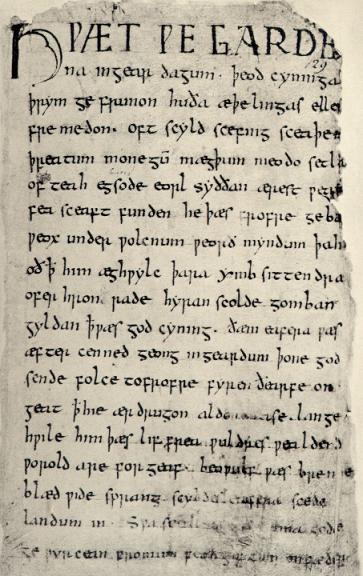
Old English initially was a diverse group of dialects, reflecting the varied origins of the Anglo-Saxon kingdoms of Britain. The Late West Saxon dialect eventually became dominant. Written Old English of AD 1000 was similar to other Germanic languages such as Old High German and Old Norse in terms of vocabulary and grammar. Written Old English is relatively unintelligible today, in contrast to written Modern English and written Middle English. Close contact with theScandinavians resulted in much grammatical simplification and lexical enrichment of the English language, which had been based on Anglo-Frisian. These changes did not reach South West England until the Norman invasion in 1066. Old English developed into a full-fledged literary language, based on the most common manner of speaking in London during the 13th century.
invitacion guys
hello this is my new blog if you want to publicate something you are welcome, thank you...
Suscribirse a:
Entradas (Atom)